
Leaser intelligence / Field note 006
A portfolio should learn faster than any property can.
Every leasing decision creates evidence. The advantage comes from knowing which lessons transfer, which remain local, and where to learn next.
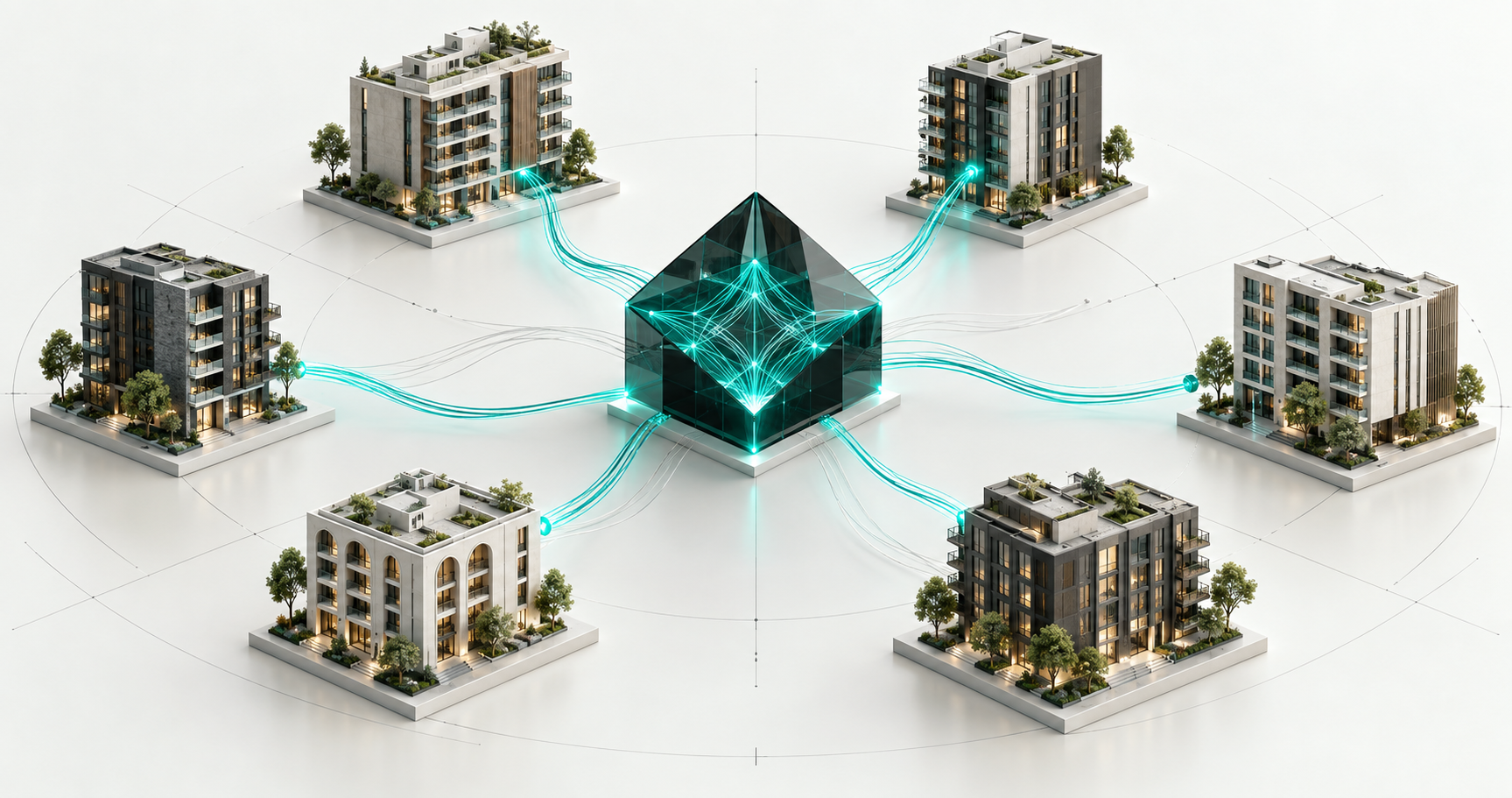
A property tests an intervention. The team reduces spend on a saturated channel, redirects demand toward exposed inventory, and protects signed-lease velocity. The result is measured. The decision worked.
Then the lesson stops at the property line.
Another asset confronts a similar pattern two weeks later and begins again—from intuition, from a dashboard, or from whichever precedent someone remembers. The portfolio owns the evidence, but it does not yet possess the ability to reuse it.
That is the difference between operating many properties and operating a learning portfolio.
One property produces an outcome.
The portfolio decides what the outcome can teach.
Every justified transfer compounds the value of the next decision.
Learning locally is necessary. Learning collectively is the advantage.
A model can improve at one property by observing the relationship between its state, an intervention, and the outcome that followed. But an enterprise system has a larger opportunity: it can compare that experience with thousands of decisions made across different assets, markets, inventory positions, seasons, and operating teams.
The objective is not to produce one universal playbook. Multifamily properties are not interchangeable. A lease-up in Phoenix, a stabilized urban high-rise, and a suburban garden community may face entirely different demand constraints even when their dashboards show the same occupancy rate.
Portfolio intelligence begins by respecting those differences. It asks whether a lesson has a credible mechanism, whether the receiving property shares the conditions that made it work, and whether the evidence is strong enough for the consequence of acting.
The transfer decision
Do not copy the action. Transfer the reason.
The action travels without the conditions, mechanism, measurement quality, or constraints that made the result meaningful.
The receiving property qualifies for the lesson only when its context and authority boundary support it.
Context is part of the evidence
Similarity is multidimensional.
Two properties can share an occupancy rate and still require opposite decisions. A useful comparison needs an operating signature—not a superficial peer group.
A lesson earns the right to travel.
Every candidate transfer should pass four tests. First, mechanism: can we explain why the intervention changed the outcome? Second, context: does the receiving property share the relevant conditions? Third, evidence: how credible and precise was the measured effect? Fourth, consequence: how much downside exists if the lesson does not generalize?
A low-cost, reversible media adjustment can travel with modest evidence and narrow bounds. A pricing or concession decision should demand stronger similarity, stronger measurement, and more human oversight. Governance should scale with consequence.
Why should this action change this outcome?
Which conditions made the result possible?
How certain are we that the action caused the lift?
What happens if the lesson fails to travel?
Three legitimate answers
Reuse, test, or refuse.
Apply within a proven boundary.
Context is comparable, evidence is strong, and the action is authorized.
Transfer as a bounded experiment.
The mechanism is plausible, but uncertainty deserves a holdout, limit, or approval.
Keep the lesson local.
The context differs, the evidence is weak, or the downside exceeds what the system may risk.
The portfolio learning loop
Evidence moves. Authority does not leak.
- ObserveRecord the property state, decision, action, and outcome.
- ExplainIdentify the mechanism and estimate incremental effect.
- IndexAttach the conditions under which the lesson may hold.
- MatchFind properties with relevant—not merely visible—similarity.
- GovernSet the transfer mode, limits, approval, and stop conditions.
- Learn againReturn the new result to portfolio memory.
The system must decide where uncertainty is worth resolving.
If a portfolio only repeats its highest-confidence action, it exploits what it already knows and leaves important uncertainty untouched. If it experiments everywhere, it spends capital and trust indiscriminately.
A learning portfolio balances both. It uses proven interventions where the expected value is clear, while reserving bounded capacity to test high-value uncertainties: an underserved segment, an exposed floorplan, a channel whose incremental role is unclear, or a property unlike anything already in memory.
The best next action is sometimes the one expected to create the most immediate lease value. Sometimes it is the safe experiment whose answer will improve hundreds of future decisions. Decision Intelligence should understand both kinds of return.
A transferable lesson has provenance
The transfer receipt
- Source
- Which property, period, and decision produced the evidence?
- Mechanism
- Why is the action believed to have changed the outcome?
- Effect
- What incremental value was measured, with what uncertainty?
- Eligibility
- Which receiving conditions must be true?
- Authority
- May the system recommend, request approval, or execute?
- Renewal
- What new outcome will strengthen, narrow, or retire the lesson?
The nonlinear advantage
The value is not more data. It is more reusable evidence.
A larger portfolio does not automatically become more intelligent. Raw scale can produce more noise, more inconsistent definitions, and more false confidence.
Compounding begins when each outcome is attached to a stable decision object: the state that was observed, the action that was authorized, the causal evidence that followed, and the conditions under which the lesson may travel.
Then one property can reduce uncertainty for another. A later property can validate or narrow the lesson. The next decision begins with a stronger prior than the last. That is a nonlinear self-improvement cycle driven by outcomes—not by the volume of tasks automated.
Build the memory honestly.
Leaser’s foundation is the decision and outcome spine required for portfolio learning: canonical property identity, shared economic definitions, intervention records, governance, and causal measurement. The demand-allocation loop creates repeated opportunities to turn real operating decisions into comparable evidence.
The next frontier is increasingly explicit transfer: richer context signatures, learned similarity, calibrated effect estimates, exploration policies, and authority that can expand or contract by decision class.
We are not claiming that every lesson already generalizes. The system earns that knowledge one measured decision at a time. The honesty of that boundary is what makes the eventual autonomy valuable.
An ecosystem creates the evidence
Portfolio memory is built together.
Property systems contribute inventory and lease truth. Demand channels contribute interventions and touchpoints. Operators contribute constraints and judgment. Measurement systems contribute causal evidence. Models contribute forecasts and similarity estimates.
Leaser connects them around a governed decision record so a lesson can move without losing its meaning, provenance, or limits.
A property remembers what happened.
A portfolio remembers when it should matter again.
That memory is the foundation for intelligence that improves faster than any asset could learn alone—and remains accountable every time it acts.
Do not broadcast best practices.